Organisations increasingly rely on strong delivery leadership, yet the distinction between Project Managers (PMs) and Program Managers (PgMs) is often misunderstood. While both roles manage change initiatives, they operate at different levels of complexity, scope, and strategic influence. Understanding the skill differences, performing structured gap analysis, and designing development pathways are essential to building a sustainable leadership pipeline.
1. Understanding the Distinction Between the Roles
Although the titles Project Manager and Program Manager are sometimes used interchangeably, they represent fundamentally different layers of organizational leadership.
A Project Manager is primarily responsible for delivering a defined scope within agreed timelines, budgets, and quality expectations. Success is measured by execution performance and delivery reliability.
A Program Manager operates at a broader level where the objective is not only to deliver outputs but to ensure that multiple coordinated initiatives collectively generate strategic value. This role focuses on aligning initiatives with enterprise priorities, managing interdependencies, and ensuring benefits realisation over time.
Consequently, the difference between the two roles is less about hierarchy and more about scope, complexity, and strategic accountability.
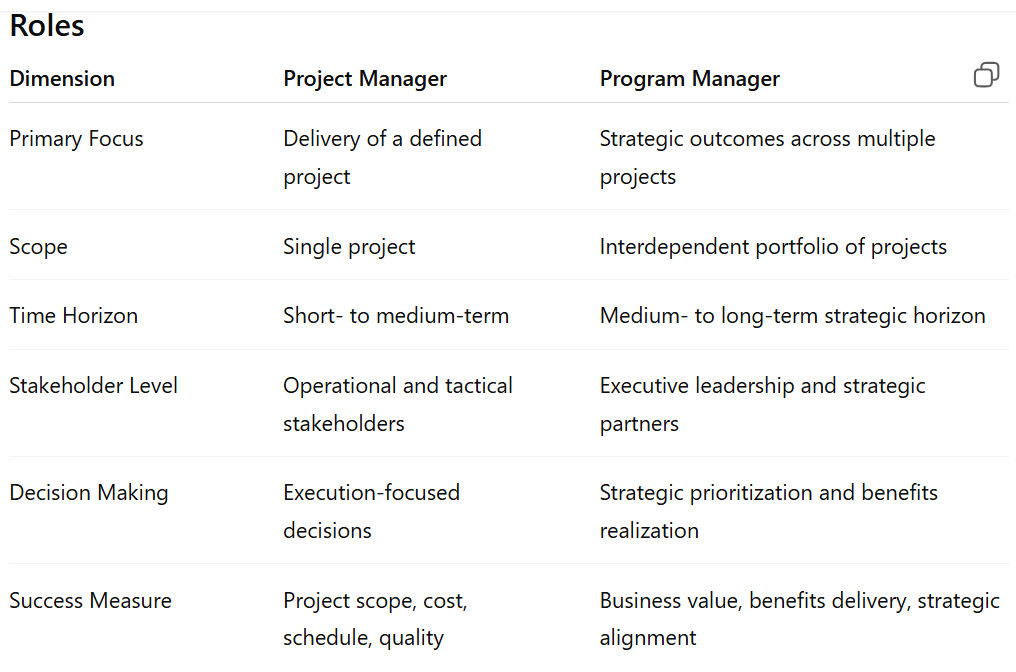
In essence, Project Managers optimise delivery, while Program Managers optimise organisational impact.
2. Skills Required for Each Role
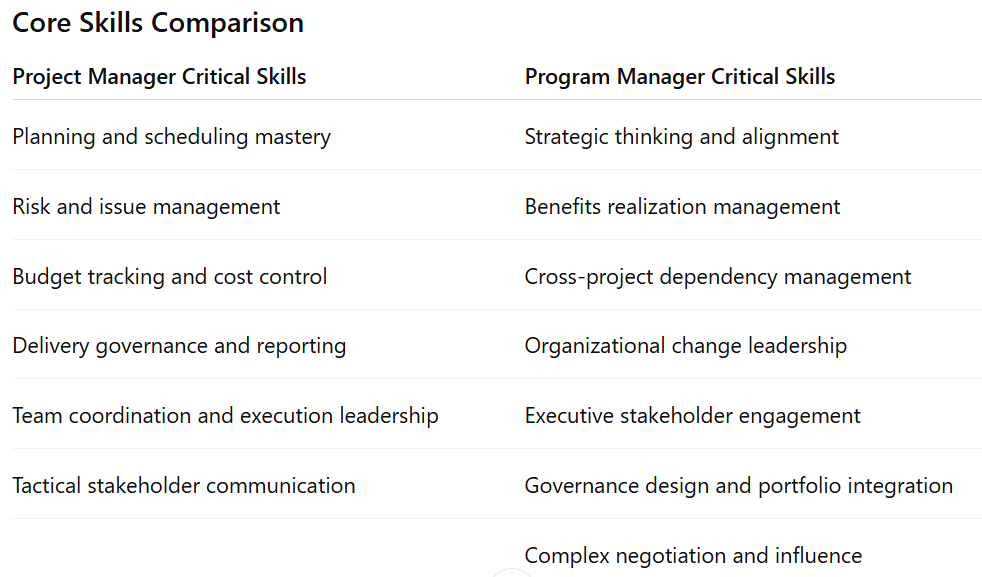
Project Managers must demonstrate strong operational execution skills, including planning, risk management, cost control, stakeholder coordination, and team leadership within a defined framework. Precision, discipline, and structured communication are key performance drivers.
Program Managers require a broader competency mix that combines operational credibility with strategic capability. They must understand how initiatives contribute to corporate strategy, manage cross-project dependencies, influence senior stakeholders, and lead organisational change. Systems thinking, financial value analysis, and enterprise governance awareness become essential differentiators.
3. Gap Analysis: Transitioning from Project Manager to Program Manager
The transition from Project Manager to Program Manager typically reveals several capability gaps. Many experienced Project Managers excel at planning and execution but may have limited exposure to long-term benefits realisation, enterprise-wide prioritisation, and strategic investment thinking. Stakeholder engagement also shifts from operational coordination to executive influence, requiring a different communication posture and stronger negotiation skills.
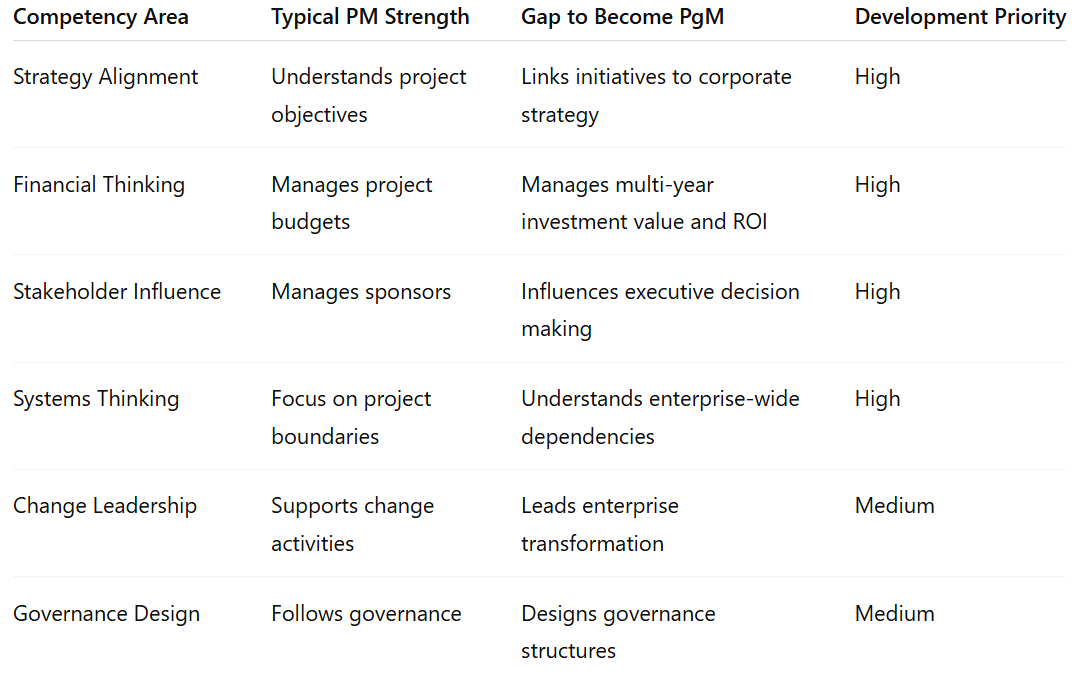
The most significant gaps are strategic perspective, enterprise thinking, and executive-level influence.
4. Attitudes and Behaviors Required for the Transition
Leadership research consistently highlights that progressing toward program leadership involves not only skill acquisition but also a transformation in mindset. Project Managers tend to focus on control, predictability, and task completion, whereas Program Managers must operate confidently in environments characterized by uncertainty, competing priorities, and evolving strategy.
Required Attitude Shifts
- From control to influence
- From delivery to value realization
- From certainty to ambiguity tolerance
- From ownership to orchestration of multiple leaders
Key Behavioral Capabilities
- Executive communication presence
- Long-term strategic thinking
- Negotiation across competing interests
- Organizational awareness and political navigation
- Coaching and leadership development mindset
The transition is therefore less about technical project tools and more about leadership maturity and systems thinking.
5. Example Individual Development Plan (IDP)
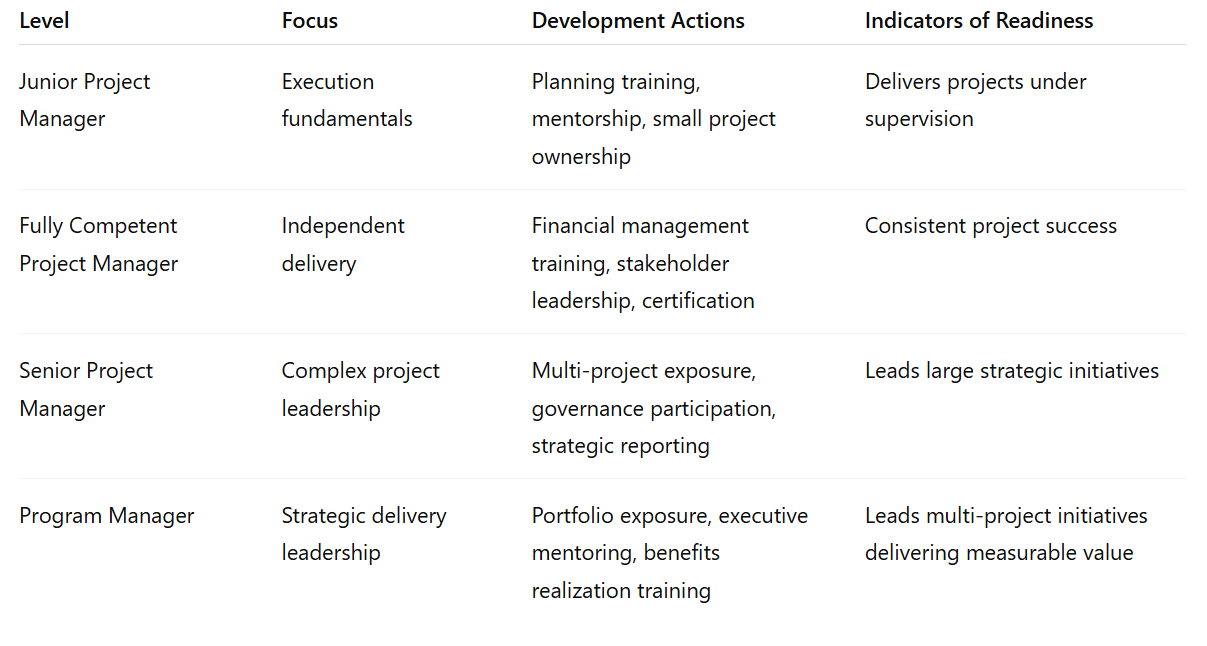
A structured Individual Development Plan provides a practical pathway for career progression and ensures readiness is competency-based rather than tenure-based.
For organisations, isolated development plans are insufficient without an integrated skill pool management approach. A structured capability pool enables leadership to map competencies across delivery roles, track readiness and progression potential, and align assignments with development objectives. It also allows organisations to anticipate capability gaps and invest in targeted development initiatives before strategic roles become vacant.
6. Importance of Internal Skill Pool Management
Skill pool management transforms talent development from an ad-hoc activity into a measurable strategic capability, ensuring continuity of leadership and consistent delivery performance.
7. Conclusion: Building the Foundation for Sustainable Leadership Progression
Sustainable progression from Project Manager to Program Manager does not occur automatically. Organisations must first establish a comprehensive skill pool management framework that clearly defines competencies, maturity levels, and readiness indicators. Once this foundation is in place, structured role categorisation and objective progression criteria can be implemented, enabling transparent movement from Junior Project Manager → Project Manager → Senior Project Manager → Program Manager.
The maturity of delivery organisations does not depend solely on methodologies or governance structures but on their ability to systematically grow leadership capability pipelines, ensuring that the right leaders are ready to assume increasingly strategic responsibilities at the right time.
Bibliography
Project Management Institute (PMI). A Guide to the Project Management Body of Knowledge (PMBOK® Guide).
Project Management Institute (PMI). The Standard for Program Management.
Axelos. Managing Successful Programmes (MSP®) Framework.
International Project Management Association (IPMA). Individual Competence Baseline (ICB). Kerzner, H. Project Management: A Systems Approach to Planning, Scheduling, and Controlling.
Thiry, M. Program Management.
Crawford, L. Developing Organizational Project Management Capability.
Categories: Advisory, Programme/Project Management