

“Culture isn’t just a backdrop — it’s the lens through which we live, work, and relate.”
When I began to build my life abroad — Belgium (where I’m from), then the UK, the Netherlands, Malaysia, and now Vietnam — I gradually understood that success in a global context depends less on technical skill than on cultural intelligence (CQ). This article is my attempt to share not just theory, but stories — so you can see how CQ plays out in real meetings, dinners, and workplace dynamics.
What Is Culture — and Why It Matters
Culture is the invisible architecture undergirding how people think, speak, behave, and interpret the world. It consists of shared assumptions, values, norms, symbols, and rituals — many of which we don’t even notice, until we bump into them.
You can think of culture as an iceberg: visible behaviors (dress code, rituals, greetings) are just the tip. Underneath lie mental models, tacit assumptions, identity signals, emotional rhythms. The deeper part is harder to change or see, yet influences everything.
In my early move from Belgium to the UK, I recall meeting a British colleague in my first week. I greeted her with a direct “Can you help me with this?” She paused, smiled, and said, “Of course — although perhaps I’d phrase it slightly differently.” That pause was cultural: in the UK, there is a little dance of politeness before direct requests. In Belgium, especially in my circles, I would have asked straightaway. That was my first lesson: even when English is shared, the cultural tone matters.

Cultural Dimensions:
Maps for NavigationTo make sense of cultural differences, scholars have proposed cultural dimensions — axes along which societies tend to vary. These are not rigid categories but tools to guide awareness.
- Hofstede’s Dimensions: Power Distance; Individualism vs Collectivism; Masculinity vs Femininity; Uncertainty Avoidance; Long-Term vs Short-Term Orientation; Indulgence vs Restraint.
- Erin Meyer’s Culture Map: Communicating (low vs high context), Evaluating, Leading (egalitarian vs hierarchical), Deciding (consensual vs top-down), Trust, Disagreeing, Scheduling.
- Bennett’s DMIS (Developmental Model of Intercultural Sensitivity): A progression from denial, through defense, minimization, acceptance, adaptation, to integration.
These lenses help you ask better questions: Is this person pausing because they disagree? Or because their culture expects space before response? Is “short term” urgency for me, or for them?
In my Vietnam context, I often apply Meyer’s communicating and disagreeing axes in real time: if someone is listening quietly, are they digesting or silently rejecting? That question shapes my next move.

Explicit vs Implicit Culture: The High-Context / Low-Context Divide
A core tension in cross-cultural work is the distinction between explicit (low-context) communication and implicit (high-context) communication.
- In explicit cultures, meaning is spelled out. Words carry primary weight; less is assumed.
- In implicit (high-context) cultures, meaning is conveyed through tone, silence, relationship, gesture, what is left unsaid.
In Malaysia and Vietnam, I learned quickly that a “yes” might not mean full agreement — it could mean “I hear you,” or “I’ll consider it,” or “I don’t want to refuse you directly.” In Belgium, UK, and the Netherlands, my reflex was to treat “yes” as commitment — which sometimes led to misalignment later.
One time in Malaysia, I suggested a procedural change in a small meeting. The senior manager replied, “That’s interesting,” and nodded. I took it as encouragement and initiated the change. Later, team operations became stiff. I learned (the hard way) to follow up: “When you say ‘interesting,’ do you mean we should move forward — or hold until you review further?”
So part of cultural intelligence is being attuned to what is not said, and having the humility to probe gently.

Workplace Behaviors: Western vs Eastern Traits — And My Country Comparisons.
Below is a refined table that contrasts generalized tendencies in Western vs Eastern workplace behavior.
In addition, I show how each of the countries I’ve lived in tends to fall (with caveats).
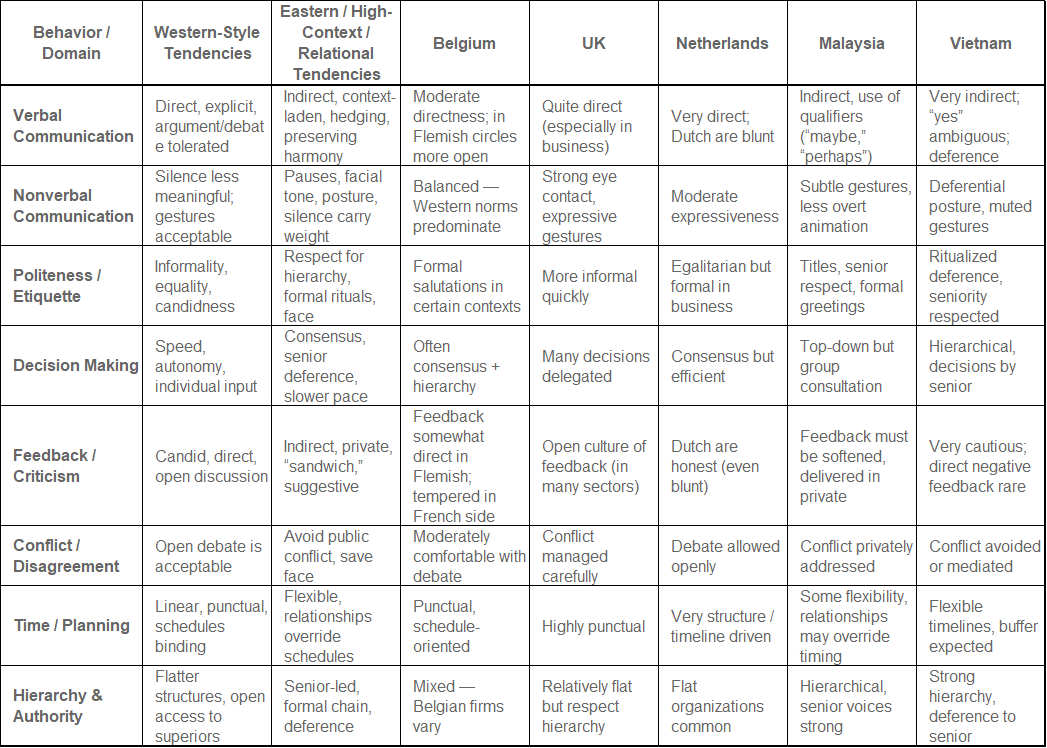
Personal reflections & cross-country notes:
- In Belgium and the Netherlands, I felt comfortable interrupting or questioning in meetings. In Malaysia and Vietnam, I learned to wait, listen, and sometimes raise questions privately.
- In Vietnam, several times in a meeting, staff would avoid contradicting a senior, even when they disagreed. I started sending a follow-up message: “If you have concerns, can you share by reply or with me one-to-one?”
- In the UK, I once offered direct feedback to a mid-level colleague. He paused, looked surprised, and later joked, “You’re very straight — I hope you don’t think I’m offended.” That taught me that even in “direct” cultures, sensitivity matters individually.
These country mappings are heuristics — not strict rules. But they sharpen your radar and help you ask intelligent questions.

What Can Go Wrong — And How to Mitigate
Here’s a distilled view of common pitfalls, their roots, and how to reduce risks — with illustrations from my journey.

In my early months in Vietnam, I underestimated the mental load of switching between Dutch bluntness and Vietnamese diplomacy. I found myself snapping in meetings. That’s when I committed to a simple rule: pause before any emotionally loaded remark. Over time, that small habit saved many misunderstandings.

Growing Cultural Intelligence (CQ): The Living Practice
CQ (Cultural Intelligence) is more than a buzzword — it’s a daily discipline. The model by Earley & Ang identifies four pillars:
- Metacognitive CQ: Awareness of your cultural assumptions; reflecting in and after interactions.
- Cognitive CQ: Knowledge of other cultures’ values, norms, historical context.
- Motivational CQ: The interest, confidence, and drive to cross cultural boundaries.
- Behavioral CQ: Ability to adapt your verbal and nonverbal actions appropriately.
Here’s how I practice these as I move between cultures:
- Metacognitive: After every cross-cultural meeting, I ask: What went well? Where did I misread? What cues did I miss? I sometimes write a short note on my phone (or later expand into a post for sdbplus.com) to capture nuance.
- Cognitive: Before moving to a country, I read local insights, history, workplace culture articles, observe local media and daily life. In Malaysia, I read Malay proverbs, local etiquette blogs, corporate culture write-ups; in Vietnam, I engaged with Vietnamese colleagues about customs around seniority, saving face, decision patterns.
- Motivational: I frame each cross-cultural encounter as a learning adventure, rather than a test. I remind myself: I’m not expected to be perfect — I’m growing my muscle.
- Behavioral: I deliberately slow my speech, pause more, soften directness, match greeting norms, test small local phrases, mirror local courtesy. In Vietnam, when in doubt, I switch to the more relational, deferential mode first, then adjust.
I also find the DMIS model helpful: moving from seeing my home culture as “normal,” to acknowledging difference, adapting, and finally integrating multiple cultural lenses.
Before critical meetings, I often use a quick Culture Map Checklist:
- What is this person’s likely communication style (direct / indirect)?
- How do they prefer feedback?
- What is the decision process (consensus or top-down)?
- How do they treat time?
- What hierarchy sensitivities exist?
Then I subtly adjust: I may lead with relational small talk; I may frame feedback as option rather than correction; I may pause longer after asking questions.

Epilogue: Culture as a Journey, Not a Destination
Writing for sdbplus.com, I often revisit my journey: from Belgian meal stories in Louveigné to navigating business dinners in Kuala Lumpur, to sensing cues in Vietnamese boardrooms. The cultural transitions have sometimes felt like waves — jolting, uncomfortable — but increasingly, they feel like dance.
If I were to sum up:
- Culture is not a barrier — it’s the deep soil in which relationships flourish or fade.
- Theory (dimensions, maps) is useful — but lived experience and reflection are your compass.
- Mistakes will happen — the key is humility, apology, adjustment.
- The more cultures you traverse, the richer your radar becomes.

Categories: Advisory, Coaching/Mentoring, Programme/Project Management
1 reply »